
The Gap Between Affinity and Immunogenicity
When a patient’s immune system recognizes a therapeutic antibody as foreign, it produces anti-drug antibodies (ADAs). The clinical consequences are severe: accelerated drug clearance, loss of therapeutic efficacy, and potentially dangerous adverse immune reactions.
In nanobody discovery campaigns (such as those run in alpacas or other camelids), this gap exists by design: You select in a camelid, but you dose a human.
Standard workflows prioritize candidates solely on binding affinity, enrichment ratios, and specificity. However, picking a winning binder and spending months reshaping a molecule that’s been already committed is an inefficient order of operations. Discovery teams need a reliable way to score humanness across the entire sequence space before committing wet-lab budget to candidate leads.
The impact of early scoring becomes clear when looking at the numbers. In a recent two-round nanobody panning campaign, every enriched clone was scored for humanness on a 0–100 scale based on its resemblance to natural human antibody repertoires. The scores spanned a wide range, from roughly 20 to 90. Crucially, 12 of the top 20 clones by round-2 enrichment scored below 70.
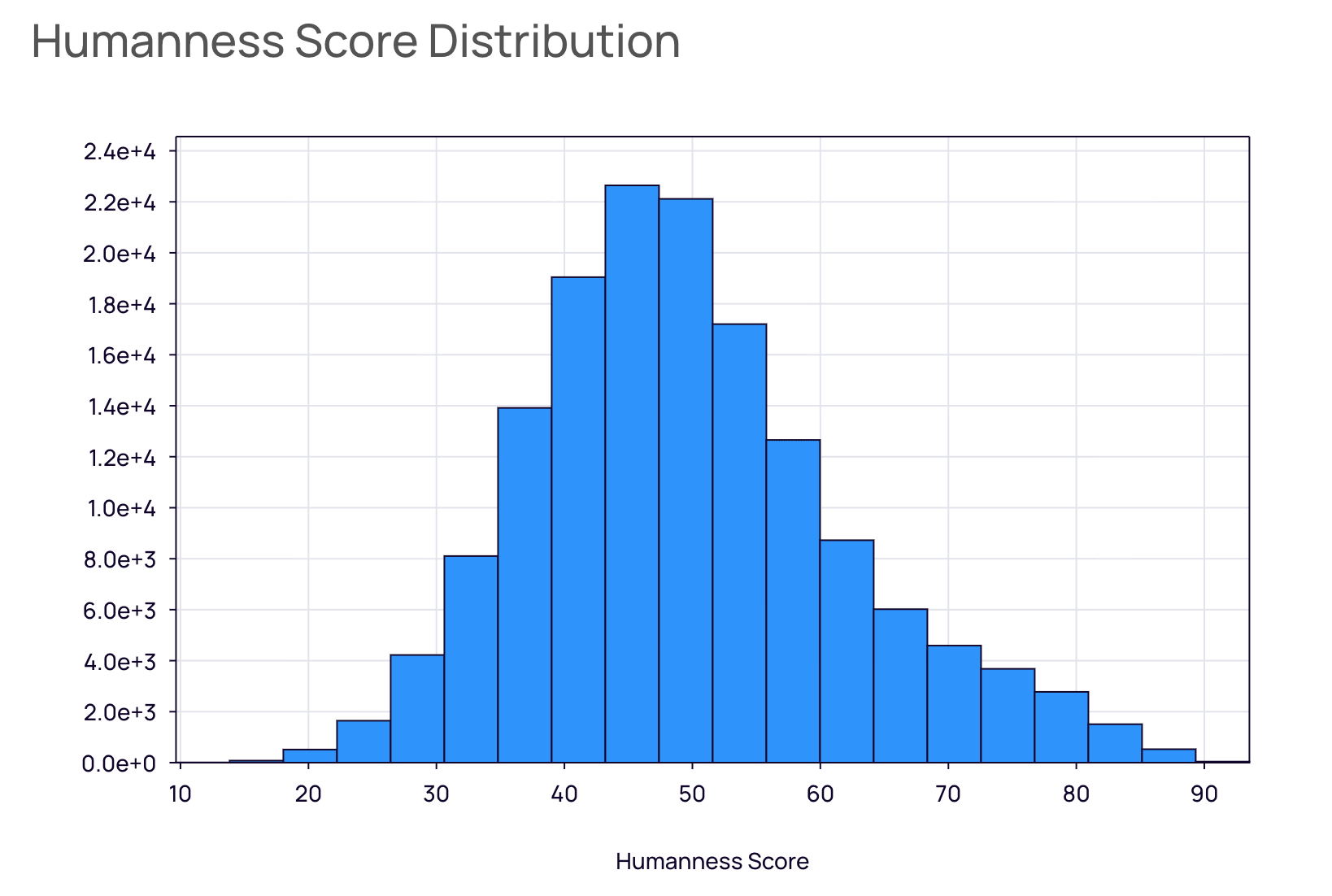
Evaluating humanness early across the entire sequence panel gives computational teams a clear, proactive order of operations: filter out high-risk leads upfront, preserve panel diversity, and protect wet-lab investments from day one.
Computational Humanness Scoring: How the OASis Method Works
To assess immunogenicity computationally before moving to expression and testing, discovery workflows leverage peptide-overlap algorithms like OASis as part of BioPhi (Prihoda et al., mAbs, 2022)
Peptide Windowing: The input antibody sequence is broken down into overlapping 9-residue peptide windows(nonamers).
Repertoire Search: Each 9-residue window is searched against a massive database of naturally occurring, naive human antibody repertoires.
Score Calculation: The sequence receives an aggregate score on a 0 to 100 scale.
A score of 100 means every 9-mer in the sequence occurs in human repertoires: the sequence reads like a natural human antibody. A score near 0 means almost none of it would be found there.
Three properties matter in practice:
No germline assignment or numbering scheme needed. The same score works for nanobodies (VHH), conventional mAbs, and scFvs.
Chains are scored separately. Paired data returns a heavy-chain and a light-chain score, so you can see which chain is pulling a candidate down. A nanobody gets one score.
It needs most of the variable domain. Scoring requires a contiguous variable region covering at least 3 of the 4 framework regions. CDR3-only clonotypes return no score.
One caveat: humanness is a proxy for immunogenicity risk, not a prediction for a given molecule. In the BioPhi study, OASis separated human from non-human antibodies with high accuracy and correlated with clinical ADA rates across more than 200 therapeutic antibodies. That is a population-level correlation. Use the score to rank comparable candidates, not to declare a molecule safe.
Methodological Workflow: Integrating Humanness into Lead Selection
Step 1: Define the Enriched Pool and Score for Humanness
The foundation of lead selection is antigen-specific enrichment. However, rather than relying on enrichment alone, we score the entire enriched dataset to establish a baseline humanness distribution. In this campaign, scores spanned a wide range from roughly 20 to 90.
A wide score spread is precisely what makes humanness a powerful selection signal. If every candidate scored within a tight range (e.g., 80–85), humanness would offer little discriminating power. A broad distribution allows computational leads to separate low-risk outliers from high-risk clones before moving to wet-lab testing.
Step 2: Map Humanness Across Sequence Space
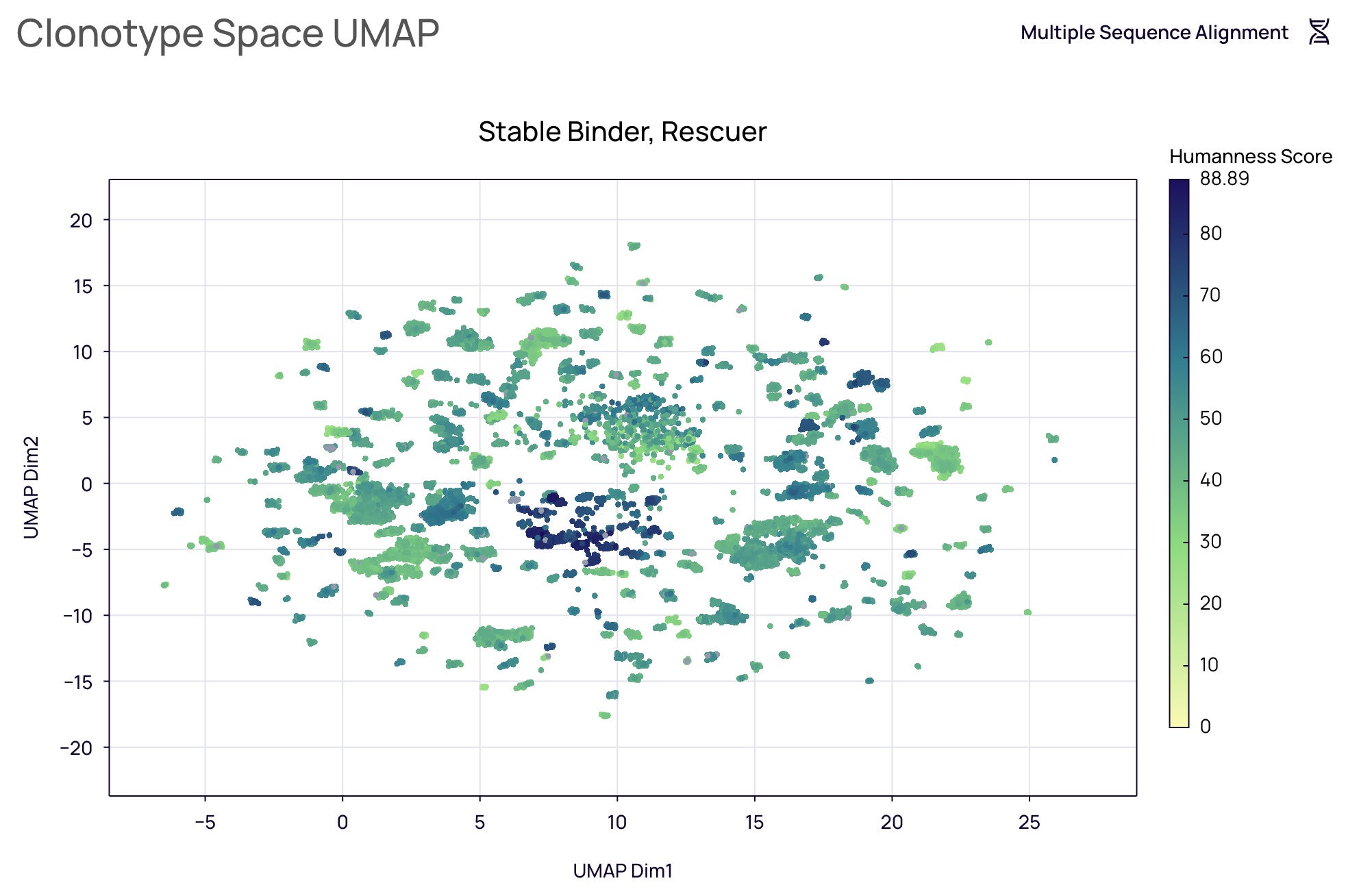
Projecting candidates onto a dimensionality reduction map (such as a sequence-space UMAP) and coloring by humanness reveals how immunological properties map onto sequence families (based on sequence similarity). Layering functional evidence (such as antigen-specificity and enrichment quality) narrows the space to viable leads.
This step highlights the central conflict in many discovery campaigns: some of the most strongly enriched clones in round 2 exhibit low humanness scores.
An enrichment-only ranking would place these high-risk clones at the very top. Visualizing humanness directly on the sequence landscape redirects attention toward candidates that achieve high enrichment and favorable humanness profiles.
Step 3: Pre-Filter on Humanness
Before ranking, apply a global humanness floor to eliminate high-risk outliers. In this campaign, setting a threshold at Humanness Score > 70 removed distant, non-human-like clones while preserving a large, high-quality candidate pool.
Methodological Note on Cutoffs: There is no universal humanness threshold. A cutoff of
70was selected based on this specific dataset’s score distribution. Cutoffs should always be set relative to your campaign’s histogram and your team’s tolerance for downstream humanization engineering.
Step 4: Rank by Humanness Within Each Cluster
A critical flaw in naive global filtering is diversity collapse. Ranking an entire library on a single metric often selects multiple variants from the same dominant lineage.
To preserve panel breadth, lead selection should combine global thresholding with local cluster ranking. Within each distinct sequence cluster, rank remaining candidates so that the most human-like variants rise to the top. This ensures that every selected sequence cluster biases toward its most human-like option without sacrificing overall structural diversity.
Candidate Selection Impact
The final lead panel consists of 30 enriched nanobodies backed by integrated evidence: enrichment signal, developability flags, and humanness scoring across multiple distinct clonal families.
Key Advantages Over Traditional Selection:
Eliminates High-Risk “Winners”: Drops the top-enriching clones that carry low humanness scores, the exact candidates that require extensive humanization or carry downstream clinical immunogenicity risks.
Preserves Clonal Breadth: Avoids over-indexing on a single dominant lineage by enforcing cluster-level diversification.
Transparent Trade-Off Analysis: Decision parameters remain fully visible and dynamic. Adjusting a threshold (e.g., shifting from
70to60) instantly demonstrates which candidates enter or leave the panel, enabling rational, audit-ready decision-making.
Watch this exact workflow live in Platforma as we map 38,000 NGS sequences to applying OASis humanness filters and local cluster ranking in real time to generate a lead panel of developable, diverse, and human-like candidates.
FAQ
What Is a Humanness Score for Antibodies?
A humanness score measures how closely an antibody sequence resembles antibodies in natural human repertoires. It is used as a proxy for immunogenicity risk: among otherwise comparable candidates, more human-like sequences are usually preferred.
How Does OASis Calculate Humanness?
OASis splits the variable domain into overlapping 9-residue windows and checks each one against peptides from human antibody repertoires in the Observed Antibody Space (OAS) database. The score is the fraction of windows found; Platforma reports it on a 0–100 scale.
What Humanness Score Cutoff Should I Use?
There is no universal cutoff. The score is designed for relative comparison within a panel. In the campaign above we pre-filtered at 70, based on that campaign’s score distribution.
Does a High Humanness Score Mean an Antibody Won’t Be Immunogenic?
No. OASis correlates with clinical anti-drug antibody rates across therapeutic antibodies, but that is a population-level relationship. Treat the score as a ranking signal, not a per-molecule immunogenicity prediction.
Can I Score Nanobodies (VHH) for Humanness?
Yes. OASis is alignment-free, so it needs no germline assignment or numbering scheme and works on VHH, mAb, and scFv sequences. A nanobody returns a single score; paired formats return one score per chain.
How Do I Combine Humanness with Panning Enrichment?
In Platforma, run Enrichment Analysis and Humanness Score on the same project, then use Lead Selection to filter on a humanness threshold and rank by humanness within each clonal cluster. Sequence Space shows both signals on one UMAP before you commit to a panel.
References
Prihoda, D., Maamary, J., Waight, A., Juan, V., Fayadat-Dilman, L., Svozil, D., & Bitton, D. A. (2022). BioPhi: A platform for antibody design, humanization, and humanness evaluation based on natural antibody repertoires and deep learning. mAbs 14(1), 2020203. doi.org/10.1080/19420862.2021.2020203
Olsen, T. H., Boyles, F., & Deane, C. M. (2022). Observed Antibody Space: A diverse database of cleaned, annotated, and translated unpaired and paired antibody sequences. Protein Science 31(1), 141–146. doi.org/10.1002/pro.4205